
The Power of Self-Love: Cultivating a Healthy Relationship with Food and Body

Taking care of ourselves inside and out

As you can see this is not the first time I have written a blog post on self-love and taking care of your body. In honor of heart health month, let’s take a deeper dive into why it is important to care of yourself as a whole. In a world often defined by external standards and pressures, nurturing a healthy relationship with food and body image is essential for our well-being. At the core of this journey lies self-love – the practice of embracing ourselves with compassion and acceptance. In this blog post, we’ll explore how cultivating self-love can transform our relationship with food and body, offering practical tips for fostering a more nourishing connection with ourselves.

**Embracing Your Journey**

Self-love begins with recognizing our inherent worth, independent of appearance or size. By embracing our uniqueness and celebrating our strengths, we lay the foundation for a compassionate relationship with ourselves and our bodies.

**Honoring Your Body’s Wisdom**

Listening to our body’s cues and nourishing ourselves with foods that satisfy and energize us is an act of self-love. By tuning into our hunger and fullness signals and trusting our body’s wisdom, we can break free from restrictive eating patterns and rediscover the joy of intuitive eating.

**Practicing Self-Compassion**

Self-love involves treating ourselves with kindness and understanding, especially when faced with challenges or setbacks. Practicing self-compassion allows us to cultivate resilience and inner strength, supporting us on our journey to healing and growth.

**Finding Joy in Nourishment**

Approaching food with gratitude and mindfulness enhances our eating experience and deepens our connection to nourishment. By savoring each bite and appreciating the flavors and textures of our meals, we can cultivate a sense of pleasure and satisfaction in eating.

**Embracing Holistic Self-Care**

Self-love extends beyond food to encompass all aspects of self-care and well-being. Engaging in activities that bring us joy and nourish our mind, body, and soul – such as spending time in nature, practicing mindfulness, or connecting with loved ones – fosters a holistic sense of well-being.

**Conclusion**

Embracing self-love is a transformative journey that empowers us to cultivate a healthy relationship with food and body. By honoring our worth, listening to our body’s wisdom, and practicing self-compassion, we can foster a deeper sense of nourishment, joy, and fulfillment in our lives. Let us embark on this journey of self-discovery and embrace the transformative power of self-love, one mindful and compassionate step at a time.

Why Should We Drink Water

Photo by Cats Coming on Pexels.com

Let me tell you something about water: it’s everywhere! From soil moisture and ice caps to the cells inside our bodies. Just like the surface of the earth, the body is made up of 60 to 70 percent. Our cells need water for our bodies to function at an optimal level. Water is one of the best cleansers our bodies need and also a healing agent for our bodies. When we don’t drink enough of it, it can lead to many signs and symptoms that we may not even realize comes from not drinking enough water.

Let me tell you some more interesting facts about water. Water is not only in the blood, but the heart and the brain is also ¾ quarts water. The lungs are made up of 83 percent water. Water helps us to lubricate the joints, regulate body temperature, and nourishes the brain and spinal cord. That alone goes to show you how many body systems can be affected if you do not drink water so the next time your joints hurt think to yourself are your joints properly lubricated? When our brain realizes that we have not had enough water it then signals the hypothalamus to release diuretic hormones which in return tells our kidneys to enable the blood to absorb and retain more water, leading to darker urine. Why do the kidneys do this? Because the body has to hold onto whatever water is available so that you do not go into full dehydration.

Now, when we drink water we need to make sure that we have the perfect balance not to drink too much and not drinking too little. Below I will list some of the symptoms we can experience when we are either dehydrated or over hydrated.

Dehydration causes:

-Drops in energy
-Mood Swings
-Skin moisture decreases
-Blood pressure
-Brain can temporarily shrink

Over hydration causes:

-The brain slows down
-Sodium electrolytes become diluted causing cells to swell
-Kidneys can’t keep up with hydration and may cause headaches vomiting seizures so drink 8 to 10 glasses a day

Did You Know?

  • When we don’t drink enough water our body responds to that by not telling us to drink enough water, and when we do drink water our body responds to that by telling us to drink more interesting right?
  • Each day we lose two to three liters of water from activities the body carries out such as breathing, sweating, urine, and  bowel movements
  • Drinking water can lower the chance of stroke, manage diabetes  and reduce the risk of some types of cancers

Reference(s):

National Association for Fitness Certification, Nutrition Coach Foundations© 3rd Ed.

Deeply Holistic. Pip Waller

The Last of the Fats – OMEGAS

photo credit: google image search

Now I know you all are pretty familiar with Omegas in the diet . For a while the omega that I would hear about the most were omega 3’s but did you know that there is omega 3,6, and 9? I know right?! That’s a lot but no worries in this blog post I will give you the run down on these fabulous omegas.

First we will start with Omega 3’s:

  • Our bodies cannot make these types of fats we must get them in our diet or with supplementation
  • They are polyunsaturated fats (chemical makeup & bond)
  • Double Bonds
  • Many types of Omega 3’s, but the most common ones are EPA, DHA, and ALA
  • EPA is a 20 chain fatty acid
  • DHA is a 22 chain fatty acid
  • ALA is a 18 chain fatty acid
  • EPA helps reduce inflammation in the body, helps with symptoms of depression
  • DHA is important for brain development and function
  • ALA is good for the heart, immune, and nervous system

Food sources of omega 3’s are:

  • salmon
  • mackerel
  • chia seeds
  • walnuts
  • flaxseeds

Omega 6:

  • Also polyunsaturated with double bonds (chemical structure)
  • Called GLA
  • Can be found in some oils such as primrose  oil
  • Benefits include possibly reducing inflammation in the body and reducing fat mass but more research is needed

Food sources of omega 6’s are:

  • soybean oil
  • mayonnaise
  • walnuts
  • almonds
  • cashew nuts

Omega 9:

  • It is monounsaturated
  • Only has one double bond in chemical structure
  • Can be produced by the body
  • Oleic Acid is the most common omega 9 known
  • Health benefits include reducing inflammation and insulin sensitivity

Food sources of omega 9’s are: 

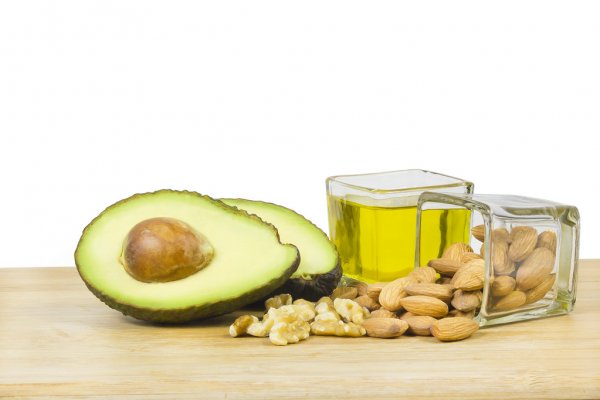
  • olive oil
  • almond oil
  • avocado oil
  • almonds
  • cashews
  • walnuts